| Original author(s) | Bram Cohen |
|---|---|
| Developer(southward) | Rainberry, Inc. |
| Initial release | 2001 (2001) |
| Repository | github |
| Standard(s) | The BitTorrent Protocol Specification[1] |
| Type | peer-to-peer file sharing |
| Website | www |
BitTorrent is a advice protocol for peer-to-peer file sharing (P2P), which enables users to distribute data and electronic files over the Internet in a decentralized manner.
To send or receive files, a person uses a BitTorrent customer on their Internet-continued computer. A BitTorrent client is a computer program that implements the BitTorrent protocol. BitTorrent clients are available for a variety of computing platforms and operating systems, including an official client released by BitTorrent, Inc. Popular clients include μTorrent, Xunlei Thunder,[ii] [3] Manual, qBittorrent, Vuze, Drench, BitComet and Tixati. BitTorrent trackers provide a listing of files available for transfer and allow the customer to find peer users, known equally "seeds", who may transfer the files.
Programmer Bram Cohen designed the protocol in April 2001, and released the beginning available version on 2 July 2001.[iv] On xv May 2017, BitTorrent, Inc. (afterward renamed Rainberry, Inc.) released BitTorrent v2 protocol specification.[five] [6] libtorrent was updated to support the new version on half dozen September 2020.[seven]
BitTorrent is one of the about common protocols for transferring big files, such as digital video files containing TV shows and video clips, or digital audio files containing songs. As of Feb 2013,[update] BitTorrent was responsible for 3.35% of all worldwide bandwidth—more than than half of the half-dozen% of total bandwidth dedicated to file sharing.[viii] In 2019, BitTorrent was a ascendant file sharing protocol and generated a substantial amount of Internet traffic, with ii.46% of downstream, and 27.58% of upstream traffic.[9] Every bit of 2013[update], BitTorrent had 15–27 million concurrent users at any time.[ten] Every bit of January 2012[update], BitTorrent is utilized past 150 1000000 active users. Based on this figure, the total number of monthly users may be estimated to more than a quarter of a billion (≈ 250 million).[eleven]
The utilize of BitTorrent may sometimes be express by Internet Service Providers (ISPs), on legal or copyright grounds.[ citation needed ] Users may choose to run seedboxes or Virtual Private Networks (VPNs) to circumvent these restrictions.
History [edit]
![[icon]](https://upload.wikimedia.org/wikipedia/commons/thumb/1/1c/Wiki_letter_w_cropped.svg/20px-Wiki_letter_w_cropped.svg.png) | This section needs expansion. You can assistance by calculation to information technology. (September 2021) |
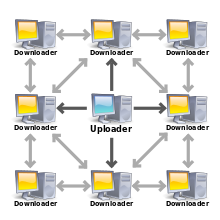
The centre calculator is acting as a "seed" to provide a file to the other computers which act equally peers
Programmer Bram Cohen, a Academy at Buffalo alumnus,[12] designed the protocol in Apr 2001, and released the get-go available version on 2 July 2001.[4]
The beginning release of the BitTorrent client had no search engine and no peer exchange. Up until 2005, the only way to share files was by creating a small text file called a "torrent", that they would upload to a torrent index site. The showtime uploader acted as a seed, and downloaders would initially connect as peers. Those who wish to download the file would download the torrent, which their client would use to connect to a tracker which had a list of the IP addresses of other seeds and peers in the swarm. In one case a peer completed a download of the complete file, information technology could in turn function equally a seed. These files contain metadata about the files to be shared and the trackers which keep rail of the other seeds and peers.
In 2005, first Vuze and and then the BitTorrent client introduced distributed tracking using distributed hash tables which immune clients to substitution data on swarms directly without the need for a torrent file.
In 2006, peer exchange functionality was added allowing clients to add together peers based on the information establish on continued nodes.
BitTorrent v2 is intended to work seamlessly with previous versions of the BitTorrent protocol. The chief reason for the update was that the former cryptographic hash function, SHA-i is no longer considered safe from malicious attacks by the developers, and as such, v2 uses SHA-256. To ensure backwards compatibility, the v2 .torrent file format supports a hybrid manner where the torrents are hashed through both the new method and the old method, with the intent that the files will be shared with peers on both v1 and v2 swarms. Another update to the specification is adding a hash tree to speed up time from adding a torrent to downloading files, and to allow more than granular checks for file corruption. In addition, each file is now hashed individually, enabling files in the swarm to be deduplicated, and then that if multiple torrents include the same files, merely seeders are merely seeding the file from some, downloaders of the other torrents can still download the file. Magnet links for v2 likewise support a hybrid style to ensure support for legacy clients.[thirteen]
Design [edit]
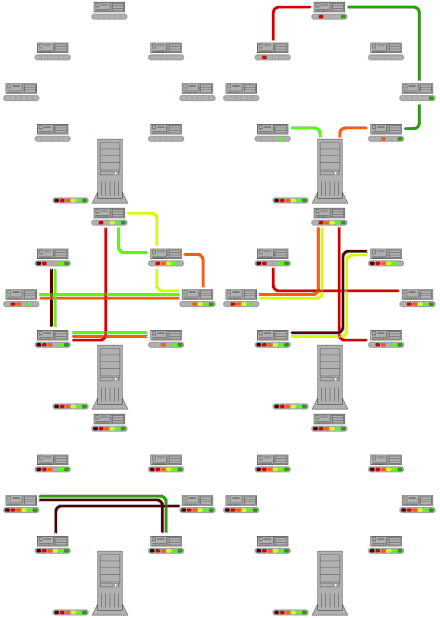
Animation of protocol use: The colored dots beneath each computer in the animation represent different parts of the file being shared. By the time a re-create to a destination computer of each of those parts completes, a copy to another destination estimator of that role (or other parts) is already taking place between users.
The BitTorrent protocol can exist used to reduce the server and network bear upon of distributing large files. Rather than downloading a file from a single source server, the BitTorrent protocol allows users to join a "swarm" of hosts to upload and download from each other simultaneously. The protocol is an alternative to the older single source, multiple mirror sources technique for distributing data, and can work finer over networks with lower bandwidth. Using the BitTorrent protocol, several basic computers, such as home computers, can replace large servers while efficiently distributing files to many recipients. This lower bandwidth usage also helps forbid large spikes in internet traffic in a given area, keeping internet speeds higher for all users in full general, regardless of whether or not they use the BitTorrent protocol.
The file beingness distributed is divided into segments called pieces. Equally each peer receives a new slice of the file, it becomes a source (of that piece) for other peers, relieving the original seed from having to send that slice to every computer or user wishing a copy. With BitTorrent, the task of distributing the file is shared by those who desire it; it is entirely possible for the seed to send only a single copy of the file itself and eventually distribute to an unlimited number of peers. Each piece is protected by a cryptographic hash contained in the torrent descriptor.[one] This ensures that any modification of the piece can be reliably detected, and thus prevents both accidental and malicious modifications of any of the pieces received at other nodes. If a node starts with an accurate copy of the torrent descriptor, information technology can verify the authenticity of the entire file it receives.
Pieces are typically downloaded non-sequentially, and are rearranged into the right order by the BitTorrent customer, which monitors which pieces it needs, and which pieces it has and can upload to other peers. Pieces are of the same size throughout a single download (for instance, a 10 MB file may be transmitted as ten 1 MB pieces or as forty 256 KB pieces). Due to the nature of this approach, the download of any file can exist halted at any fourth dimension and be resumed at a later date, without the loss of previously downloaded information, which in turn makes BitTorrent peculiarly useful in the transfer of larger files. This too enables the client to seek out readily available pieces and download them immediately, rather than halting the download and waiting for the next (and possibly unavailable) piece in line, which typically reduces the overall time of the download. This eventual transition from peers to seeders determines the overall "wellness" of the file (every bit determined by the number of times a file is available in its complete form).
The distributed nature of BitTorrent can lead to a flood-like spreading of a file throughout many peer reckoner nodes. Equally more peers bring together the swarm, the likelihood of a successful download past any particular node increases. Relative to traditional Internet distribution schemes, this permits a meaning reduction in the original benefactor'due south hardware and bandwidth resource costs. Distributed downloading protocols in general provide back-up against system bug, reduce dependence on the original distributor,[fourteen] and provide sources for the file which are more often than not transient and therefore in that location is no single point of failure equally in one way server-client transfers.
Though both ultimately transfer files over a network, a BitTorrent download differs from a one way server-customer download (as is typical with an HTTP or FTP asking, for example) in several fundamental ways:
- BitTorrent makes many small data requests over different IP connections to different machines, while server-client downloading is typically made via a unmarried TCP connection to a single auto.
- BitTorrent downloads in a random or in a "rarest-first"[15] arroyo that ensures loftier availability, while classic downloads are sequential.
Taken together, these differences permit BitTorrent to reach much lower toll to the content provider, much higher redundancy, and much greater resistance to corruption or to "flash crowds" than regular server software. Nevertheless, this protection, theoretically, comes at a cost: downloads tin can take fourth dimension to rise to full speed because it may take time for enough peer connections to be established, and it may take time for a node to receive sufficient data to become an effective uploader. This contrasts with regular downloads (such equally from an HTTP server, for example) that, while more than vulnerable to overload and corruption, rise to full speed very quickly, and maintain this speed throughout. In the offset, BitTorrent's non-contiguous download methods made it harder to support "streaming playback". In 2014, the client Popcorn Time allowed for streaming of BitTorrent video files. Since and then, more and more than clients are offering streaming options.
Searching [edit]
The BitTorrent protocol provides no way to index torrent files. As a upshot, a comparatively pocket-size number of websites have hosted a large majority of torrents, many linking to copyrighted works without the say-so of copyright holders, rendering those sites especially vulnerable to lawsuits.[16] A BitTorrent index is a "listing of .torrent files, which typically includes descriptions" and information nigh the torrent's content.[17] Several types of websites support the discovery and distribution of data on the BitTorrent network. Public torrent-hosting sites such as The Pirate Bay let users to search and download from their collection of torrent files. Users can typically also upload torrent files for content they wish to distribute. Often, these sites likewise run BitTorrent trackers for their hosted torrent files, but these two functions are not mutually dependent: a torrent file could be hosted on one site and tracked by another unrelated site. Private host/tracker sites operate like public ones except that they may restrict access to registered users and may also proceed track of the amount of information each user uploads and downloads, in an attempt to reduce "leeching".
Web search engines allow the discovery of torrent files that are hosted and tracked on other sites; examples include The Pirate Bay and BTDigg. These sites allow the user to enquire for content meeting specific criteria (such equally containing a given discussion or phrase) and retrieve a list of links to torrent files matching those criteria. This list can frequently be sorted with respect to several criteria, relevance (seeders-leechers ratio) being one of the virtually pop and useful (due to the way the protocol behaves, the download bandwidth achievable is very sensitive to this value). Metasearch engines let one to search several BitTorrent indices and search engines at once.
The Tribler BitTorrent client was among the beginning to incorporate congenital-in search capabilities. With Tribler, users can observe .torrent files held by random peers and taste buddies.[18] Information technology adds such an power to the BitTorrent protocol using a gossip protocol, somewhat similar to the eXeem network which was shut down in 2005. The software includes the ability to recommend content too. After a dozen downloads, the Tribler software can roughly guess the download taste of the user, and recommend boosted content.[19]
In May 2007, researchers at Cornell University published a newspaper proposing a new approach to searching a peer-to-peer network for inexact strings,[20] which could replace the functionality of a cardinal indexing site. A year afterward, the same team implemented the system as a plugin for Vuze called Cubit[21] and published a follow-up paper reporting its success.[22]
A somewhat like facility but with a slightly different approach is provided by the BitComet client through its "Torrent Exchange"[23] feature. Whenever two peers using BitComet (with Torrent Exchange enabled) connect to each other they substitution lists of all the torrents (name and info-hash) they take in the Torrent Share storage (torrent files which were previously downloaded and for which the user chose to enable sharing by Torrent Exchange). Thus each customer builds upwards a list of all the torrents shared by the peers it connected to in the electric current session (or information technology tin can even maintain the list between sessions if instructed).
At any time the user tin search into that Torrent Collection listing for a sure torrent and sort the list past categories. When the user chooses to download a torrent from that list, the .torrent file is automatically searched for (by info-hash value) in the DHT Network and when institute it is downloaded by the querying client which can after that create and initiate a downloading job.
Downloading and sharing [edit]
Users find a torrent of interest on a torrent index site or by using a search engine congenital into the customer, download information technology, and open it with a BitTorrent client. The client connects to the tracker(due south) or seeds specified in the torrent file, from which it receives a list of seeds and peers currently transferring pieces of the file(s). The customer connects to those peers to obtain the various pieces. If the swarm contains only the initial seeder, the client connects directly to it, and begins to asking pieces. Clients incorporate mechanisms to optimize their download and upload rates.
The effectiveness of this data substitution depends largely on the policies that clients utilize to determine to whom to send data. Clients may prefer to transport data to peers that ship information back to them (a "tit for tat" commutation scheme), which encourages off-white trading. But strict policies often result in suboptimal situations, such as when newly joined peers are unable to receive any information considering they don't have any pieces withal to trade themselves or when two peers with a good connectedness betwixt them do not exchange data merely because neither of them takes the initiative. To counter these effects, the official BitTorrent client plan uses a mechanism chosen "optimistic unchoking", whereby the client reserves a portion of its available bandwidth for sending pieces to random peers (not necessarily known adept partners, so called preferred peers) in hopes of discovering even ameliorate partners and to ensure that newcomers go a chance to join the swarm.[24]
Although "swarming" scales well to tolerate "flash crowds" for popular content, it is less useful for unpopular or niche marketplace content. Peers arriving after the initial rush might find the content unavailable and need to wait for the arrival of a "seed" in order to complete their downloads. The seed inflow, in plough, may take long to happen (this is termed the "seeder promotion problem"). Since maintaining seeds for unpopular content entails high bandwidth and authoritative costs, this runs counter to the goals of publishers that value BitTorrent as a cheap alternative to a client-server approach. This occurs on a huge scale; measurements have shown that 38% of all new torrents become unavailable within the first month.[25] A strategy adopted by many publishers which significantly increases availability of unpopular content consists of bundling multiple files in a unmarried swarm.[26] More sophisticated solutions have also been proposed; generally, these employ cross-torrent mechanisms through which multiple torrents can cooperate to meliorate share content.[27]
Creating and publishing [edit]
| | This article needs to be updated. The reason given is: Some extensions described in this section as experimental take been standardized. This section is factually incorrect almost some aspects of v1 and v2.. (Jan 2022) |

The peer distributing a information file treats the file as a number of identically sized pieces, unremarkably with byte sizes of a power of two, and typically between 32 kB and xvi MB each. The peer creates a hash for each piece, using the SHA-one hash part, and records it in the torrent file. Pieces with sizes greater than 512 kB volition reduce the size of a torrent file for a very large payload, simply is claimed to reduce the efficiency of the protocol.[28] When another peer afterward receives a item piece, the hash of the piece is compared to the recorded hash to test that the slice is error-costless.[1] Peers that provide a complete file are chosen seeders, and the peer providing the initial copy is called the initial seeder. The exact information independent in the torrent file depends on the version of the BitTorrent protocol.
By convention, the name of a torrent file has the suffix .torrent. Torrent files accept an "announce" section, which specifies the URL of the tracker, and an "info" section, containing (suggested) names for the files, their lengths, the piece length used, and a SHA-one hash code for each piece, all of which are used by clients to verify the integrity of the data they receive. Though SHA-ane has shown signs of cryptographic weakness, Bram Cohen did not initially consider the risk large plenty for a astern incompatible change to, for example, SHA-iii. As of BitTorrent v2 the hash function has been updated to SHA-256.[29]
In the early days, torrent files were typically published to torrent index websites, and registered with at least one tracker. The tracker maintained lists of the clients currently connected to the swarm.[one] Alternatively, in a trackerless system (decentralized tracking) every peer acts every bit a tracker. Azureus was the first[thirty] BitTorrent client to implement such a organization through the distributed hash table (DHT) method. An alternative and incompatible DHT organisation, known as Mainline DHT, was released in the Mainline BitTorrent client 3 weeks afterward (though information technology had been in development since 2002)[thirty] and later adopted by the μTorrent, Transmission, rTorrent, KTorrent, BitComet, and Deluge clients.
Afterward the DHT was adopted, a "private" flag – analogous to the circulate flag – was unofficially introduced, telling clients to restrict the use of decentralized tracking regardless of the user'southward desires.[31] The flag is intentionally placed in the info section of the torrent so that it cannot be disabled or removed without irresolute the identity of the torrent. The purpose of the flag is to prevent torrents from being shared with clients that practice non have access to the tracker. The flag was requested for inclusion in the official specification in August 2008, only has not been accepted yet.[32] Clients that have ignored the individual flag were banned by many trackers, discouraging the practice.[33]
Anonymity [edit]
BitTorrent does not, on its ain, offer its users anonymity. One tin normally see the IP addresses of all peers in a swarm in one's own customer or firewall program. This may betrayal users with insecure systems to attacks.[24] In some countries, copyright organizations scrape lists of peers, and send takedown notices to the internet access provider of users participating in the swarms of files that are under copyright. In some jurisdictions, copyright holders may launch lawsuits against uploaders or downloaders for infringement, and police may arrest suspects in such cases.
Various ways have been used to promote anonymity. For case, the BitTorrent client Tribler makes available a Tor-similar onion network, optionally routing transfers through other peers to obscure which customer has requested the data. The go out node would be visible to peers in a swarm, just the Tribler organization provides exit nodes. One advantage of Tribler is that clearnet torrents tin can exist downloaded with only a small decrease in download speed from one "hop" of routing.
i2p provides a similar anonymity layer although in that case, one can only download torrents that have been uploaded to the i2p network.[34] The bittorrent client Vuze allows users who are not concerned virtually anonymity to take clearnet torrents, and make them available on the i2p network.[35]
Nigh BitTorrent clients are not designed to provide anonymity when used over Tor,[36] and there is some debate as to whether torrenting over Tor acts as a elevate on the network.[37]
Private torrent trackers are usually invitation simply, and require members to participate in uploading, simply have the downside of a unmarried centralized indicate of failure. Oink's Pinkish Palace and What.cd are examples of private trackers which have been shut downwardly.
Seedbox services download the torrent files beginning to the company's servers, assuasive the user to direct download the file from at that place.[38] [39] I's IP address would be visible to the Seedbox provider, but not to third parties.
Virtual private networks encrypt transfers, and substitute a different IP address for the user'due south, then that anyone monitoring a torrent swarm will simply see that address.
Associated technologies [edit]
Distributed trackers [edit]
On 2 May 2005, Azureus 2.3.0.0 (now known as Vuze) was released,[40] introducing support for "trackerless" torrents through a arrangement called the "distributed database." This organization is a Distributed hash table implementation which allows the client to use torrents that practise not take a working BitTorrent tracker. Instead merely bootstrapping server is used (router.bittorrent.com, dht.transmissionbt.com or router.utorrent.com[41] [42]). The post-obit calendar month, BitTorrent, Inc. released version 4.2.0 of the Mainline BitTorrent client, which supported an alternative DHT implementation (popularly known as "Mainline DHT", outlined in a draft on their website) that is incompatible with that of Azureus. In 2014, measurement showed concurrent users of Mainline DHT to be from ten one thousand thousand to 25 meg, with a daily churn of at least 10 million.[43]
Current versions of the official BitTorrent client, μTorrent, BitComet, Transmission and BitSpirit all share compatibility with Mainline DHT. Both DHT implementations are based on Kademlia.[44] As of version 3.0.five.0, Azureus likewise supports Mainline DHT in addition to its own distributed database through use of an optional application plugin.[45] This potentially allows the Azureus/Vuze client to attain a bigger swarm.
Another idea that has surfaced in Vuze is that of virtual torrents. This idea is based on the distributed tracker approach and is used to describe some spider web resource. Currently, it is used for instant messaging. It is implemented using a special messaging protocol and requires an appropriate plugin. Anatomic P2P is another approach, which uses a decentralized network of nodes that route traffic to dynamic trackers. Most BitTorrent clients as well use Peer exchange (PEX) to assemble peers in addition to trackers and DHT. Peer exchange checks with known peers to see if they know of whatever other peers. With the 3.0.v.0 release of Vuze, all major BitTorrent clients now accept compatible peer exchange.
Spider web seeding [edit]
Spider web "seeding" was implemented in 2006 as the ability of BitTorrent clients to download torrent pieces from an HTTP source in add-on to the "swarm". The reward of this characteristic is that a website may distribute a torrent for a item file or batch of files and make those files available for download from that same web server; this can simplify long-term seeding and load balancing through the utilise of existing, cheap, web hosting setups. In theory, this would brand using BitTorrent nearly every bit easy for a spider web publisher as creating a direct HTTP download. In addition, it would allow the "spider web seed" to exist disabled if the swarm becomes too popular while still allowing the file to exist readily bachelor. This feature has ii distinct specifications, both of which are supported past Libtorrent and the 26+ clients that utilize it.
The first was created by John "TheSHAD0W" Hoffman, who created BitTornado.[46] [47] This kickoff specification requires running a spider web service that serves content by info-hash and piece number, rather than filename.
The other specification is created by GetRight authors and can rely on a bones HTTP download space (using byte serving).[48] [49]
In September 2010, a new service named Burnbit was launched which generates a torrent from any URL using webseeding.[l] There are server-side solutions that provide initial seeding of the file from the spider web server via standard BitTorrent protocol and when the number of external seeders attain a limit, they terminate serving the file from the original source.[51]
[edit]
A technique chosen broadcatching combines RSS feeds with the BitTorrent protocol to create a content delivery system, further simplifying and automating content distribution. Steve Gillmor explained the concept in a column for Ziff-Davis in Dec 2003.[52] The word spread speedily amidst bloggers (Ernest Miller,[53] Chris Pirillo, etc.). In an article entitled Broadcatching with BitTorrent, Scott Raymond explained:
I want RSS feeds of BitTorrent files. A script would periodically check the feed for new items, and employ them to start the download. Then, I could detect a trusted publisher of an Allonym RSS feed, and "subscribe" to all new episodes of the show, which would and then starting time downloading automatically – similar the "season pass" feature of the TiVo.
—Scott Raymond, scottraymond.net[54]
The RSS feed will rail the content, while BitTorrent ensures content integrity with cryptographic hashing of all information, so feed subscribers will receive uncorrupted content. One of the kickoff and popular software clients (free and open source) for broadcatching is Miro. Other costless software clients such as PenguinTV and KatchTV are besides at present supporting broadcatching. The BitTorrent web-service MoveDigital added the power to make torrents bachelor to any spider web application capable of parsing XML through its standard REST-based interface in 2006,[55] though this has since been discontinued. Additionally, Torrenthut is developing a similar torrent API that will provide the aforementioned features, and assist bring the torrent community to Web 2.0 standards. Alongside this release is a offset PHP application built using the API called PEP, which will parse any Really Elementary Syndication (RSS 2.0) feed and automatically create and seed a torrent for each enclosure found in that feed.[56]
Throttling and encryption [edit]
Since BitTorrent makes upwardly a large proportion of total traffic, some ISPs have chosen to "throttle" (slow down) BitTorrent transfers. For this reason, methods take been developed to disguise BitTorrent traffic in an endeavour to thwart these efforts.[57] Protocol header encrypt (PHE) and Message stream encryption/Protocol encryption (MSE/PE) are features of some BitTorrent clients that attempt to make BitTorrent hard to notice and throttle. As of November 2015, Vuze, Bitcomet, KTorrent, Manual, Deluge, μTorrent, MooPolice, Halite, qBittorrent, rTorrent, and the latest official BitTorrent client (v6) support MSE/PE encryption.
In Baronial 2007, Comcast was preventing BitTorrent seeding by monitoring and interfering with the advice betwixt peers. Protection confronting these efforts is provided by proxying the client-tracker traffic via an encrypted tunnel to a indicate outside of the Comcast network.[58] In 2008, Comcast called a "truce" with BitTorrent, Inc. with the intention of shaping traffic in a protocol-agnostic style.[59] Questions most the ideals and legality of Comcast'south behavior have led to renewed debate about net neutrality in the United States.[lx] In full general, although encryption can brand it hard to determine what is existence shared, BitTorrent is vulnerable to traffic analysis. Thus, even with MSE/PE, information technology may be possible for an Internet access provider to recognize BitTorrent and likewise to determine that a system is no longer downloading only but uploading data, and terminate its connection past injecting TCP RST (reset flag) packets.
Multitrackers [edit]
Another unofficial feature is an extension to the BitTorrent metadata format proposed by John Hoffman[61] and implemented by several indexing websites. Information technology allows the use of multiple trackers per file, then if one tracker fails, others tin continue to support file transfer. It is implemented in several clients, such as BitComet, BitTornado, BitTorrent, KTorrent, Transmission, Deluge, μTorrent, rtorrent, Vuze, and Frostwire. Trackers are placed in groups, or tiers, with a tracker randomly called from the peak tier and tried, moving to the next tier if all the trackers in the summit tier fail.
Torrents with multiple trackers can subtract the time it takes to download a file, but also have a few consequences:
- Poorly implemented[62] clients may contact multiple trackers, leading to more than overhead-traffic.
- Torrents from closed trackers suddenly become downloadable past non-members, as they tin connect to a seed via an open tracker.
Peer choice [edit]
As of Dec 2008,[update] BitTorrent, Inc. was working with Oversi on new Policy Discover Protocols that query the ISP for capabilities and network architecture information. Oversi'due south Isp hosted NetEnhancer box is designed to "improve peer selection" by helping peers detect local nodes, improving download speeds while reducing the loads into and out of the Internet service provider's network.[63]
Implementations [edit]
The BitTorrent specification is free to use and many clients are open source, and then BitTorrent clients have been created for all common operating systems using a multifariousness of programming languages. The official BitTorrent client, μTorrent, qBittorrent, Transmission, Vuze, and BitComet are some of the most popular clients.[64] [65] [66] [67]
Some BitTorrent implementations such as MLDonkey and Torrentflux are designed to run every bit servers. For example, this tin exist used to centralize file sharing on a single dedicated server which users share access to on the network.[68] Server-oriented BitTorrent implementations can also be hosted past hosting providers at co-located facilities with loftier bandwidth Internet connectivity (e.one thousand., a datacenter) which can provide dramatic speed benefits over using BitTorrent from a regular home broadband connection. Services such equally ImageShack tin download files on BitTorrent for the user, allowing them to download the entire file by HTTP in one case information technology is finished.
The Opera web browser supports BitTorrent natively.[69] Brave web browser ships with an extension which supports WebTorrent, a BitTorrent-similar protocol based on WebRTC instead of UDP and TCP.[seventy] [71] BitLet allowed users to download Torrents directly from their browser using a Java applet (until browsers removed support for Java applets).[72] [ commendation needed ] An increasing number of hardware devices are beingness made to support BitTorrent. These include routers and NAS devices containing BitTorrent-capable firmware similar OpenWrt. Proprietary versions of the protocol which implement DRM, encryption, and authentication are found inside managed clients such as Pando.
Adoption [edit]
A growing number of individuals and organizations are using BitTorrent to distribute their own or licensed works (e.chiliad. indie bands distributing digital files of their new songs). Independent adopters report that BitTorrent applied science reduces demands on private networking hardware and bandwidth, an essential for non-profit groups with large amounts of internet traffic.[73]
Some uses of BitTorrent for file sharing may violate laws in some jurisdictions (see legislation section).
Picture show, video, and music [edit]
- BitTorrent Inc. has obtained a number of licenses from Hollywood studios for distributing popular content from their websites.[ citation needed ]
- Sub Pop Records releases tracks and videos via BitTorrent Inc.[74] to distribute its 1000+ albums. Babyshambles and The Libertines (both bands associated with Pete Doherty) have extensively used torrents to distribute hundreds of demos and live videos. U.s. industrial rock band 9 Inch Nails frequently distributes albums via BitTorrent.
- Podcasting software is starting to integrate BitTorrent to help podcasters bargain with the download demands of their MP3 "radio" programs. Specifically, Juice and Miro (formerly known every bit Republic Actor) support automatic processing of .torrent files from RSS feeds. Similarly, some BitTorrent clients, such every bit μTorrent, are able to procedure web feeds and automatically download content constitute within them.
- DGM Live purchases are provided via BitTorrent.[75]
- VODO, a service which distributes "free-to-share" movies and TV shows via BitTorrent.[76] [77] [78]
Broadcasters [edit]
- In 2008, the CBC became the first public broadcaster in North America to make a full bear witness (Canada'south Next Great Prime number Minister) available for download using BitTorrent.[79]
- The Norwegian Broadcasting Corporation (NRK) has since March 2008 experimented with bittorrent distribution, available online.[eighty] Just selected works in which NRK owns all royalties are published. Responses take been very positive, and NRK is planning to offering more than content.
- The Dutch VPRO broadcasting organization released four documentaries in 2009 and 2010 nether a Creative Commons license using the content distribution feature of the Mininova tracker.[81] [82] [83]
Cloud Service Providers [edit]
- The Amazon AWS'due south Simple Storage Service (S3), until April 29, 2021, had supported sharing of saucepan objects with BitTorrent protocols. As of June 13, 2020, the characteristic is only available in service regions launched afterward May 30, 2016.[84] [85] [86] The feature for the existing customers volition exist extended for an additional 12 months post-obit the deprecation. After Apr 29, 2022, BitTorrent clients volition no longer connect to Amazon S3.
Software [edit]
- Blizzard Entertainment uses BitTorrent (via a proprietary client called the "Blizzard Downloader", associated with the Blizzard "BattleNet" network) to distribute content and patches for Diablo III, StarCraft II and Earth of Warcraft, including the games themselves.[87]
- Wargaming uses BitTorrent in their popular titles World of Tanks, World of Warships and World of Warplanes to distribute game updates.[88]
- CCP Games, maker of the space simulation MMORPG Eve Online, has announced that a new launcher will be released that is based on BitTorrent.[89] [xc]
- Many software games, especially those whose big size makes them difficult to host due to bandwidth limits, extremely frequent downloads, and unpredictable changes in network traffic, will distribute instead a specialized, stripped down BitTorrent customer with plenty functionality to download the game from the other running clients and the primary server (which is maintained in example not enough peers are available).
- Many major open source and free software projects encourage BitTorrent every bit well every bit conventional downloads of their products (via HTTP, FTP etc.) to increase availability and to reduce load on their own servers, particularly when dealing with larger files.[91]
- Resilio Sync is a BitTorrent-based[92] binder-syncing tool which can act as an culling to server-based synchronisation services such as Dropbox.
Government [edit]
- The British government used BitTorrent to distribute details near how the taxation money of British citizens was spent.[93] [94]
Education [edit]
- Florida State University uses BitTorrent to distribute large scientific data sets to its researchers.[95]
- Many universities that have BOINC distributed computing projects take used the BitTorrent functionality of the client-server organization to reduce the bandwidth costs of distributing the customer-side applications used to process the scientific data. If a BOINC distributed computing application needs to be updated (or just sent to a user), it can do so with niggling impact on the BOINC server.[96]
- The developing Human Connectome Project uses BitTorrent to share their open dataset.[97]
- Bookish Torrents is a BitTorrent tracker for use by researchers in fields that need to share large datasets[98] [99]
Others [edit]
- Facebook uses BitTorrent to distribute updates to Facebook servers.[100]
- Twitter uses BitTorrent to distribute updates to Twitter servers.[101] [102]
- The Internet Archive added BitTorrent to its file download options for over 1.3 million existing files, and all newly uploaded files, in August 2012.[103] [104] This method is the fastest means of downloading media from the Archive.[103] [105]
By early 2015, AT&T estimated that BitTorrent accounted for 20% of all broadband traffic.[106]
Routers that utilize network address translation (NAT) must maintain tables of source and destination IP addresses and ports. Because BitTorrent often contacts 20–thirty servers per 2nd, the NAT tables of some consumer-course routers are rapidly filled. This is a known cause of some home routers ceasing to work correctly.[107] [108]
Legislation [edit]
Although the protocol itself is legal,[109] problems stem from using the protocol to traffic copyright infringing works, since BitTorrent is oftentimes used to download otherwise paid content, such as movies and video games. There has been much controversy over the use of BitTorrent trackers. BitTorrent metafiles themselves do not shop file contents. Whether the publishers of BitTorrent metafiles violate copyrights by linking to copyrighted works without the authorization of copyright holders is controversial. Diverse jurisdictions accept pursued legal action confronting websites that host BitTorrent trackers.
Loftier-profile examples include the closing of Suprnova.org, TorrentSpy, LokiTorrent, BTJunkie, Mininova, Oink's Pink Palace and What.cd. BitTorrent search engine The Pirate Bay torrent website, formed by a Swedish group, is noted for the "legal" section of its website in which letters and replies on the subject of declared copyright infringements are publicly displayed. On 31 May 2006, The Pirate Bay's servers in Sweden were raided past Swedish police force on allegations by the MPAA of copyright infringement;[110] however, the tracker was upward and running over again three days subsequently. In the report used to value NBC Universal in its merger with Comcast, Envisional examined the 10,000 torrent swarms managed past PublicBT which had the about active downloaders. After excluding pornographic and unidentifiable content, it was found that only one swarm offered legitimate content.[111]
In the U.s., more than 200,000 lawsuits take been filed for copyright infringement on BitTorrent since 2010.[112] In the United Kingdom, on 30 April 2012, the Loftier Courtroom of Justice ordered five ISPs to block The Pirate Bay.[113]
Security [edit]
One concern is the UDP flood attack. BitTorrent implementations ofttimes use μTP for their communication. To achieve high bandwidths, the underlying protocol used is UDP, which allows spoofing of source addresses of internet traffic. It has been possible to carry out Denial-of-service attacks in a P2P lab environment, where users running BitTorrent clients act every bit amplifiers for an assail at another service.[114] However this is not always an effective assault because ISPs can cheque if the source address is correct.
Several studies on BitTorrent found files available for download containing malware. In particular, ane small sample indicated that 18% of all executable programs available for download independent malware.[115] Another study claims that as much as 14.5% of BitTorrent downloads contain zip-day malware, and that BitTorrent was used as the distribution mechanism for 47% of all aught-day malware they have found.[116]
Encounter as well [edit]
- Anonymous P2P
- Anti-Counterfeiting Trade Agreement
- Bencode
- Cache Discovery Protocol
- Comparison of BitTorrent clients
- Comparison of BitTorrent sites
- Comparing of BitTorrent tracker software
- Glossary of BitTorrent terms
- Magnet URI scheme
- Simple file verification
- Super-seeding
- Torrent poisoning
References [edit]
- ^ a b c d Cohen, Bram (October 2002). "BitTorrent Protocol 1.0". BitTorrent.org. Archived from the original on 8 February 2014. Retrieved 1 June 2020.
- ^ Van der Sar, Ernesto (4 December 2009). "Thunder Blasts uTorrent's Market Share Away - TorrentFreak". TorrentFreak. Archived from the original on 20 February 2016. Retrieved 18 June 2018.
- ^ "迅雷-全球共享计算与区块链创领者". Xunlei.com . Retrieved 21 Nov 2019.
- ^ a b Cohen, Bram (2 July 2001). "BitTorrent – a new P2P app". Yahoo eGroups. Archived from the original on 29 Jan 2008. Retrieved 15 April 2007.
- ^ "Merge pull request #59 from the8472/new-hash-algos". BitTorrent. 15 May 2017. Retrieved xiii September 2021.
- ^ Cohen, Bram. "The BitTorrent Protocol Specification v2". BitTorrent.org. BitTorrent. Retrieved 28 Oct 2020.
- ^ Norberg, Arvid (seven September 2020). "Bittorrent-v2". libtorrent.org. libtorrent. Retrieved 28 October 2020.
{{cite web}}: CS1 maint: url-status (link) - ^ "Awarding Usage & Threat Report". Palo Alto Networks. 2013. Archived from the original on 31 October 2013. Retrieved seven April 2013.
- ^ Marozzo, Fabrizio; Talia, Domenico; Trunfio, Paolo (2020). "A Sleep-and-Wake technique for reducing free energy consumption in BitTorrent networks". Concurrency and Ciphering: Practise and Experience. 32 (xiv). doi:10.1002/cpe.5723. ISSN 1532-0634. S2CID 215841734.
- ^ Wang, Liang; Kangasharju, J. (1 September 2013). "Measuring large-scale distributed systems: Example of Bit Torrent Mainline DHT". IEEE P2P 2013 Proceedings. pp. 1–ten. doi:10.1109/P2P.2013.6688697. ISBN978-1-4799-0515-7. S2CID 5659252. Archived from the original on 18 November 2015. Retrieved 7 January 2016.
- ^ "BitTorrent and μTorrent Software Surpass 150 Million User Milestone". Bittorrent.com. nine Jan 2012. Archived from the original on 26 March 2014. Retrieved ix July 2012.
- ^ "UB Engineering science Tweeter". University at Buffalo's School of Technology and Applied Sciences. Archived from the original on eleven November 2013. Retrieved 4 January 2022.
- ^ "Bittorrent-v2". libbittorrent.org. libbittorrent. Retrieved 28 October 2020.
- ^ Menasche, Daniel S.; Rocha, Antonio A. A.; de Souza e Silva, Edmundo A.; Leao, Rosa Chiliad.; Towsley, Don; Venkataramani, Arun (2010). "Estimating Self-Sustainability in Peer-to-Peer Swarming Systems". Operation Evaluation. 67 (xi): 1243–1258. arXiv:1004.0395. doi:10.1016/j.peva.2010.08.013. S2CID 9361889. by D. Menasche, A. Rocha, E. de Souza due east Silva, R. M. Leao, D. Towsley, A. Venkataramani.
- ^ Urvoy-Keller (December 2006). "Rarest First and Choke Algorithms Are Enough" (PDF). SIGCOMM. Archived (PDF) from the original on 23 May 2012. Retrieved 9 March 2012.
- ^ Ernesto (12 July 2009). "PublicBT Tracker Set To Patch BitTorrent' Achilles' Heel". Torrentfreak. Archived from the original on 26 March 2014. Retrieved 14 July 2009.
- ^ Chwan-Hwa (John) Wu, J. David Irwin. Introduction to Computer Networks and Cybersecurity. Chapter 5.four.: Partially Centralized Architectures. CRC Press. four February 2013. ISBN 9781466572133
- ^ Zeilemaker, N., Capotă, M., Bakker, A., & Pouwelse, J. (2011). "Tribler P2P Media Search and Sharing." Proceedings of the 19th ACM International Conference on Multimedia - MM 'eleven.
- ^ "DecentralizedRecommendation –". Tribler.org. Archived from the original on 2 December 2008. Retrieved ix July 2012.
- ^ Wong, Bernard; Vigfusson, Ymir; Gun Sirer, Emin (ii May 2007). "Hyperspaces for Object Clustering and Estimate Matching in Peer-to-Peer Overlays" (PDF). Cornell University. Archived (PDF) from the original on 17 June 2012. Retrieved seven April 2013.
- ^ Wong, Bernard (2008). "Cubit: Gauge Matching for Peer-to-Peer Overlays". Cornell Academy. Archived from the original on 31 December 2012. Retrieved 26 May 2008.
- ^ Wong, Bernard. "Gauge Matching for Peer-to-Peer Overlays with Cubit" (PDF). Cornell University. Archived (PDF) from the original on 29 October 2008. Retrieved 26 May 2008.
- ^ "Torrent Commutation". Archived from the original on 5 October 2013. Retrieved 31 Jan 2010.
The torrent sharing characteristic of BitComet. Bitcomet.com.
- ^ a b Tamilmani, Karthik (25 October 2003). "Studying and enhancing the BitTorrent protocol". Stony Beck Academy. Archived from the original (DOC) on 19 November 2004. Retrieved 6 May 2006.
- ^ Kaune, Sebastian; et al. (2009). "Unraveling BitTorrent'southward File Unavailability: Measurements and Analysis". arXiv:0912.0625 [cs.NI].
- ^ D. Menasche; et al. (1–4 December 2009). Content Availability and Bundling in Swarming Systems (PDF). CoNEXT'09. Rome, Italy: ACM via sigcomm.org. ISBN978-1-60558-636-6. Archived (PDF) from the original on 1 May 2011. Retrieved 18 Dec 2009.
- ^ Kaune, Sebastian; et al. "The Seeder Promotion Problem: Measurements, Analysis and Solution Infinite" (PDF). Queen Mary'south University London. Archived (PDF) from the original on 9 August 2014. Retrieved 20 July 2017.
- ^ "BitTorrent Specification". Wiki.theory.org. Archived from the original on 26 June 2013. Retrieved nine July 2012. [ dubious ]
- ^ "» BitTorrent v2". Retrieved 27 September 2020.
- ^ a b Jones, Ben (vii June 2015). "BitTorrent's DHT Turns x Years Old". TorrentFreak. Archived from the original on 11 June 2015. Retrieved 5 July 2015.
- ^ "Unofficial BitTorrent Protocol Specification v1.0". Archived from the original on 14 December 2006. Retrieved 4 Oct 2009. [ dubious ]
- ^ Harrison, David (3 August 2008). "Private Torrents". Bittorrent.org. Archived from the original on 24 March 2013. Retrieved 4 October 2009.
- ^ "BitComet Banned From Growing Number of Individual Trackers". Archived from the original on 26 March 2014. Retrieved 4 October 2009.
- ^ "I2P Compared to Tor - I2P". Archived from the original on 22 December 2015. Retrieved 16 Dec 2015.
- ^ "I2PHelper HowTo - VuzeWiki". Archived from the original on xx October 2017. Retrieved sixteen December 2015.
- ^ "Bittorrent over Tor isn't a good idea - The Tor Web log". Archived from the original on thirteen October 2016. Retrieved 2 October 2016.
- ^ Inc., The Tor Project. "Tor Project: FAQ". Archived from the original on 22 October 2016. Retrieved 2 Oct 2016.
- ^ "This Website Could Be The Ultimate All-In-I Torrent Machine". 8 April 2016. Archived from the original on 8 April 2016.
- ^ "Torrent From the Cloud With Seedr - TorrentFreak". 17 Jan 2016. Archived from the original on 19 April 2016. Retrieved 8 Apr 2016.
- ^ "Vuze Changelog". Azureus.sourceforge.net. Archived from the original on 1 December 2006.
- ^ "DHT Bootstrap Update | The BitTorrent Engineering Blog". engineering science.bittorrent.com . Retrieved 21 Nov 2019.
- ^ GitHub - bittorrent/bootstrap-dht: DHT bootstrap server, BitTorrent Inc., eleven November 2019, retrieved 21 November 2019
- ^ Wang, Liang; Kangasharju, Jussi. (2013). "Measuring Large-Calibration Distributed Systems: Case of BitTorrent Mainline DHT" (PDF). IEEE Peer-to-Peer. Archived (PDF) from the original on 12 May 2014. Retrieved 15 May 2014.
- ^ "Khashmir.SourceForge.net". Khashmir.SourceForge.cyberspace. Archived from the original on 2 July 2012. Retrieved nine July 2012.
- ^ "plugins.vuze.com". plugins.vuze.com. Archived from the original on 1 August 2012. Retrieved 9 July 2012.
- ^ "HTTP-Based Seeding Specification". BitTornado.com. Archived from the original (TXT) on 20 March 2004. Retrieved 9 May 2006.
- ^ John Hoffman, DeHackEd (25 February 2008). "HTTP Seeding – BitTorrent Enhancement Proposal № 17". Archived from the original on 13 December 2013. Retrieved 17 February 2012.
- ^ "HTTP/FTP Seeding for BitTorrent". GetRight.com. Archived from the original on 28 December 2009. Retrieved 18 March 2010.
- ^ Michael Burford (25 February 2008). "WebSeed – HTTP/FTP Seeding (GetRight style) – BitTorrent Enhancement Proposal № 19". Bittorrent.org. Archived from the original on xiii December 2013. Retrieved 17 February 2012.
- ^ "Burn Any Web-Hosted File into a Torrent With Burnbit". TorrentFreak. 13 September 2010. Archived from the original on nine August 2011. Retrieved 9 July 2012.
- ^ "PHP based torrent file creator, tracker and seed server". PHPTracker. Archived from the original on 19 December 2013. Retrieved 9 July 2012.
- ^ Gillmor, Steve (13 December 2003). "BitTorrent and RSS Create Disruptive Revolution". EWeek.com. 14 December 2003. Retrieved 22 April 2007.
- ^ Miller, Ernest (two March 2004). "BitTorrent + RSS = The New Broadcast". Archived from the original on 23 Oct 2013. . The Importance of... Corante.com.
- ^ Raymond, Scott (sixteen December 2003). "Broadcatching with BitTorrent". scottraymond.net. Archived from the original on 13 February 2004.
- ^ "MoveDigital API REST functions". Move Digital. 2006. Archived from the original on 11 August 2006. Retrieved 9 May 2006. Documentation.
- ^ "Prodigem Enclosure Puller(pep.txt)". Prodigem.com. Archived from the original (TXT) on 26 May 2006. Retrieved 9 May 2006. via Internet Wayback Car.
- ^ "Encrypting Bittorrent to take out traffic shapers". Torrentfreak.com. 5 February 2006. Archived from the original on 26 March 2014. Retrieved 9 May 2006.
- ^ "Comcast Throttles BitTorrent Traffic, Seeding Impossible". Archived from the original on 11 Oct 2013. , TorrentFreak, 17 Baronial 2007.
- ^ Broache, Anne (27 March 2008). "Comcast and BitTorrent Agree to Collaborate". News.com. Archived from the original on 9 May 2008. Retrieved nine July 2012.
- ^ Soghoian, Chris (four September 2007). "Is Comcast's BitTorrent filtering violating the law?". Cnet.com. Archived from the original on fifteen July 2010. Retrieved 9 July 2012.
- ^ "BEP12: Multitracker Metadata Extension". BitTorrent Inc. Archived from the original on 27 December 2012. Retrieved 28 March 2013.
- ^ "P2P:Protocol:Specifications:Multitracker". wiki.depthstrike.com. Archived from the original on 26 March 2014. Retrieved xiii November 2009. [ dubious ]
- ^ Johnston, Casey (9 December 2008). "Arstechnica.com". Arstechnica.com. Archived from the original on 12 December 2008. Retrieved nine July 2012.
- ^ Van Der Sar, Ernesto (four Dec 2009). "Thunder Blasts uTorrent's Market Share Abroad". TorrentFreak. Archived from the original on 7 December 2009. Retrieved 15 September 2011.
- ^ "uTorrent Dominates BitTorrent Client Market Share". TorrentFreak. 24 June 2009. Archived from the original on 3 April 2014. Retrieved 25 June 2013.
- ^ "Windows Public File Sharing Market place Share 2015". opswat. Archived from the original on fourteen April 2016. Retrieved 1 April 2016.
- ^ Henry, Alan. "Almost Popular BitTorrent Client 2015". lifehacker. Archived from the original on ix Apr 2016. Retrieved 1 April 2016.
- ^ "Torrent Server combines a file server with P2P file sharing". Turnkeylinux.org. Archived from the original on 7 July 2012. Retrieved ix July 2012.
- ^ Anderson, Nate (one February 2007). "Does network neutrality mean an terminate to BitTorrent throttling?". Ars Technica, LLC. Archived from the original on 16 Dec 2008. Retrieved 9 February 2007.
- ^ Mark (7 May 2020). "How to Stream Movies and Download Torrent Files in Brave Browser". Browser Pulse. Retrieved six October 2020.
- ^ "What extensions are built into Brave?". Brave Help Heart . Retrieved 8 Jan 2022.
{{cite spider web}}: CS1 maint: url-status (link) - ^ Bahgat, Alessandro (10 October 2008). "BitLet - Bittorrent applet". Alessandro Bahgat . Retrieved 8 January 2022.
- ^ See for instance "eight Legal Uses for BitTorrent". 17 Baronial 2013. Archived from the original on 5 May 2021. The Internet Archive
- ^ "Sub Popular page on BitTorrent.com". Archived from the original on xiv January 2007. Retrieved thirteen December 2006.
- ^ "DGMlive.com". DGMlive.com. Archived from the original on 11 November 2013. Retrieved ix July 2012.
- ^ "VODO – About...". Retrieved fifteen April 2012. (WebCite).
- ^ Cory Doctorow (15 October 2009). "Vodo: a filesharing service for film-makers". Boing Boing. Happy Mutants LLC. Retrieved xv April 2012. (WebCite)
- ^ Ernesto. "Pioneer One, The BitTorrent Exclusive TV-Serial Continues". TorrentFreak. Retrieved 15 April 2012. (WebCite)
- ^ "CBC to BitTorrent Canada'south Side by side Great Prime Government minister". CBC News. 19 March 2008. Archived from the original on fourteen June 2010. Retrieved nineteen March 2008.
- ^ "Bittorrent" (in Norwegian). Nrkbeta.no. 2008. Archived from the original on 24 October 2013. Retrieved seven April 2013.
- ^ "Torrents uploaded by EeuwvandeStad". MiniNova. 2009. Archived from the original on four November 2013. Retrieved 7 April 2013.
- ^ Denters, Thousand. (eleven August 2010). "Tegenlicht – Download California Dreaming". VPRO.nl. Archived from the original on 26 March 2014. Retrieved 7 Apr 2013.
- ^ Bol, M. (1 October 2009). "Tegenlicht – VPRO gemeengoed" (in Dutch). VPRO.nl. Archived from the original on 26 March 2014. Retrieved 7 April 2013.
- ^ "Announcements virtually S3 BitTorrent discontinuation shouldn't be buried in the commit history · Issue #27 · awsdocs/amazon-s3-userguide". GitHub . Retrieved 30 September 2021.
- ^ "Periodic update - 2021-05-13 · awsdocs/amazon-s3-userguide@0d17598". GitHub . Retrieved 30 September 2021.
- ^ "Using BitTorrent with Amazon S3 - Amazon Simple Storage Service". xiii June 2020. Archived from the original on xiii June 2020. Retrieved xxx September 2021.
- ^ "Blizzard Downloader". Curse Inc. 4 November 2010. Archived from the original on 26 March 2014. Retrieved iv November 2010.
- ^ "World of Tanks FAQ". Wargaming. fifteen Dec 2014. Archived from the original on xviii December 2014. Retrieved 15 Dec 2014.
- ^ MJ Guthrie (11 March 2013). "EVE Online reconfiguring launcher to utilize BitTorrent". Massively.joystiq.com. Archived from the original on 13 February 2014. Retrieved 7 April 2013.
- ^ CCP Games (20 July 2010). "All quiet on the EVE Launcher forepart? – EVE Community". Community.eveonline.com. Archived from the original on 13 March 2013. Retrieved seven April 2013.
- ^ "Complete Download Options List – BitTorrent". Ubuntu.com. Archived from the original on 24 Apr 2010. Retrieved 7 May 2009.
- ^ "BitTorrent Sync engineering science". Archived from the original on 30 August 2013. Retrieved 29 August 2013.
- ^ HM Government (4 September 2012). "Combined Online Information System". Data.Gov.Uk Beta. Controller of Her Majesty's Stationery Office. Archived from the original on 26 March 2014. Retrieved 7 September 2012.
- ^ Ernesto (4 June 2010). "Britain Government Uses BitTorrent to Share Public Spending Data". TorrentFreak. Archived from the original on 27 October 2013. Retrieved 7 September 2012.
- ^ "HPC Data Repository". Florida State Academy. Archived from the original on ii April 2013. Retrieved 7 April 2013.
- ^ Costa, Fernando; Silva, Luis; Fedak, Gilles; Kelley, Ian (2008). "Optimizing the information distribution layer of BOINC with Bit Torrent". 2008 IEEE International Symposium on Parallel and Distributed Processing. IEEE International Symposium on Parallel and Distributed Processing, 2008. IPDPS 2008. IEEE. p. 1. doi:10.1109/IPDPS.2008.4536446. ISBN978-ane-4244-1693-6. S2CID 13265537. (registration required)
- ^ "Torrents Help Researchers Worldwide to Study Babies' Brains". Torrent Freak. 3 June 2017. Archived from the original on 5 January 2018. Retrieved 4 January 2018.
- ^ "Bookish Torrents Website". Retrieved four May 2020.
- ^ Miccoli, Fräntz (2014). "Academic Torrents: Bringing P2P Technology to the Academic World". MyScienceWork . Retrieved 6 May 2020.
- ^ Ernesto (25 June 2010). "Facebook Uses BitTorrent, and They Dearest It". Torrent Freak. Torrent Freak. Archived from the original on nineteen April 2014. Retrieved 7 September 2012.
- ^ Ernesto (10 February 2010). "Twitter Uses BitTorrent For Server Deployment". Torrent Freak. Torrent Freak. Archived from the original on 26 March 2014. Retrieved 7 September 2012.
- ^ Ernesto (16 July 2010). "BitTorrent Makes Twitter's Server Deployment 75x Faster". Torrent Freak. Torrent Freak. Archived from the original on 26 March 2014. Retrieved vii September 2012.
- ^ a b Ernesto (7 August 2012). "Internet Archive Starts Seeding ane,398,875 Torrents". TorrentFreak. Archived from the original on 8 August 2012. Retrieved 7 Baronial 2012.
- ^ "Hot List for bt1.the states.annal.org (Updated August 7, 2012, seven:31 pm PDT)". Archived from the original on three August 2012. Retrieved 8 August 2012. . Archive.org.
- ^ "Welcome to Archive torrents". Archived from the original on 19 January 2016. Retrieved 22 December 2015. . Annal.org. 2012.
- ^ "AT&T Patents System to 'Fast-Lane' BitTorrent Traffic". TheStack.com. 8 May 2006. Archived from the original on 23 February 2015. Retrieved 5 March 2015.
- ^ "FAQ:Modems/routers that are known to have problems with P2P apps". uTorrent.com. Archived from the original on 13 September 2008. Retrieved vii April 2013.
- ^ Halkes, Gertjan; Pouwelse, Johan (2011). Jordi Domingo-Pascual; et al. (eds.). UDP NAT and Firewall Puncturing in the Wild. NETWORKING 2011:10th International IFIP TC 6 Networking Conference, Valencia, Espana, May nine–thirteen, 2011, Proceedings. Springer. p. 7. ISBN9783642207976. Archived from the original on 9 May 2013. Retrieved seven April 2013.
- ^ "Is torrenting safe? Is it illegal? Are you likely to be defenseless?". 29 November 2018. Archived from the original on vi Oct 2018. Retrieved 5 October 2018.
- ^ "The Piratebay is Downward: Raided by the Swedish Police". TorrentFreak. 31 May 2006. Archived from the original on 16 Apr 2014. Retrieved 20 May 2007.
- ^ "Technical report: An Guess of Infringing Utilise of the Net" (PDF). Envisional. 1 Jan 2011. Archived (PDF) from the original on 25 Apr 2012. Retrieved 6 May 2012.
- ^ "BitTorrent: Copyright Lawyers' Favourite Target Reaches 200,000 Lawsuits". The Guardian. ix August 2011. Archived from the original on 4 Dec 2013. Retrieved 10 January 2014.
- ^ Albanesius, Chloe (30 April 2012). "U.K. High Court Orders ISPs to Cake The Pirate Bay". PC Magazine. Archived from the original on 25 May 2013. Retrieved half-dozen May 2012.
- ^ Adamsky, Florian (2015). "P2P File-Sharing in Hell: Exploiting BitTorrent Vulnerabilities to Launch Distributed Reflective DoS Attacks". Archived from the original on 1 October 2015. Retrieved 21 Baronial 2015.
- ^ Berns, Andrew D.; Jung, Eunjin (EJ) (24 April 2008). "Searching for Malware in Bit Torrent". University of Iowa, via TechRepublic. Archived from the original on 1 May 2013. Retrieved 7 April 2013. (registration required)
- ^ Vegge, Håvard; Halvorsen, Finn Michael; Nergård, Rune Walsø (2009). Where Only Fools Dare to Tread: An Empirical Written report on the Prevalence of Nil-Day Malware (PDF). 2009 Fourth International Briefing on Internet Monitoring and Protection. IEEE Computer Society. p. 66. doi:10.1109/ICIMP.2009.19. ISBN978-1-4244-3839-vi. S2CID 15567480. Archived from the original (PDF (orig. work + pub. paper)) on 17 June 2013.
Further reading [edit]
- Pouwelse, Johan; et al. (2005). "The Bittorrent P2P File-Sharing System: Measurements and Analysis". Peer-to-Peer Systems Four. Lecture Notes in Information science. Vol. 3640. Berlin: Springer. pp. 205–216. doi:10.1007/11558989_19. ISBN978-three-540-29068-1 . Retrieved 4 September 2011.
- Czerniawski, Michal (20 December 2009). "Responsibleness of Bittorrent Search Engines for Copyright Infringements". SSRN. doi:10.2139/ssrn.1540913. SSRN 1540913.
- Cohen, Bram (16 February 2005). "Under the hood of BitTorrent". Calculator Systems Colloquium (EE380). Stanford University.
External links [edit]
 | Wikimedia Commons has media related to BitTorrent. |
- Official website
- Specification
- BitTorrent at Curlie
- Unofficial BitTorrent Protocol Specification v1.0 at wiki.theory.org
- Unofficial BitTorrent Location-enlightened Protocol one.0 Specification at wiki.theory.org
DOWNLOAD HERE
Posted by: willhitelact1964.blogspot.com


0 Komentar
Post a Comment